Monday, November 5, 2012

The Talking Crayon Box


Click on the Video tab view this fantastic clip of the book.

The Talking Crayon Box is a classic story that highlights the importance of placing value on diversity.  Read the book to your students and ask them to write about their thoughts.  Younger students can even create an illustration on a crayon template.


Quotes from Wilma Rudolph


Students:  Write on paper/pencil or post a comment in the blog comment section.

How does this quote from Wilma Rudolph relate to your every day life?  Explain connections and expand on why she would be a positive role model.  Link your response to one of C.A.R.E.S traits.

"Never underestimate the power of dreams and the influence of the human spirit.  We are all the same in this notion:  The potential for greatness lives within each of us."

"Winning is great, sure, but if you are really going to do something in life, the secret is learning how to lose.  Nobody goes undefeated all the time.  If you can pick up after a crushing defeat, and go on to win again, you are going to be a champion someday."


Quotes from Fridah

Students may make connections and reflect on Fridah's words.  Responses may be in the form of blog comments or paper pencil.  Check out the quotes below.


"Painting completes my life..."

"Feet what do I need you for when I have wings to fly?"


Friday, November 2, 2012

5 tools for your Culturally Responsive Writing Centers

The purpose of a Culturally Responsive Writing Center is to increase the level of engagement for your students.  You can set up a little nook in your classroom where students go to write narratives and responses to culturally responsive images.

Include the following items:

1) Teacher-Student exchange journals
2) Family photos that students can use to create stories
3) Cultural Objects that represent the students ( You may send a letter home and ask students to collect items that represent traditions and family values.)
4) Quotes from famous minority figures


Monday, September 24, 2012

Using a Multicultural Text as a Springboard for Goal Setting


Mrs. Jasper and her teaching assistant wanted to use a space theme for their classroom this year.  So, I suggested reading one of my favorite books called, Ron's Big Mission.  It's about a young African-American boy who decides to make an important risk in an effort to educate himself.  This book is a must read for goal setting during the first few months of school.

The students created mission badges to represent their long term goals and special qualities.

Two Books to Empower Your Students


Click below for detailed activities and templates.
scholastic lesson plan STAND TALL
I AM Poem Electronic Template

Stand Tall, Molly Lou Melon is a great self-empowerment tool to help your students understand and appreciate their own special contributions and uniqueness in the world.

Me I AM is simply a classic.  It places an esteemed value on each individual child!  The illustrations are  remarkable examples of multicultural detail.

Tuesday, August 21, 2012

The Power of Memoir and Film Narratives

I am thrilled about starting my first year in fourth grade.  I am continuously planning with the "Culturally Responsive" framework in mine.  During the first three weeks of schools, our fourth grade team will be guiding students through the writing process for producing a narrative based on an influential life event.  After moving through the writing process, each student will be producing an iMovie.  The students' work will be shown a local film festival.  This activity not only reflects the diverse experiences of students, but it also weaves in critical technology skills.  In addition, the students are analyzing, synthesizing, and creating knowledge through both a writing and technology medium.  Students will be given a wide range of choices to create their film narratives which include: a comic strip with scanned documents, personal family photos, and audio of the "Where I'm From" poem template.  Choice will be a deeply embedded Culturally Responsive Teaching strategy to keep students engaged.

I would like to give Janelle Catlett a special thank you for exposing us to a dynamic mentor text that can be used to teach narrative writing and bio poems.  Check out Mama, Where Are You From?  She also walked us through the entire IMovie process.

Saturday, June 16, 2012

Increasing Reading Growth Over the Summer

I am in the process of creating summer packets to mail to my students to motivate daily reading, writing, and math problem solving.  A significant portion of my students don't necessarily have a large selection of books at home, but I discovered that every one of my students has access to the internet at home.  Research indicates that students can lose up to two levels of growth over the summer.  On my quest to find the answer to this complex problem, I stumbled across another teacher's blog.  She's truly incredible, and I found out about the "We Give Books" site from one of her posts.  The "We Give Books" website allows students to read books online for free.  This site is a twenty-first century example of using technology to promote equity in education.  "We Give Books" gives every student with internet access the gift of reading.  Click on the link below to browse the site.
Online Books Link
Check out the "Panicked Teacher" blog for more amazing resources.
Panicked Teacher Blog Link

Saturday, May 26, 2012

Suggestions for Ending the Year in a Culturally Responsive Way

Many teachers give their students an end of the year gift.  This year I will send each student home with a little beach bag that includes the items listed below.  I will print the message that I came up with below and put it inside the beach bag.


Chex Mix – Represents our diverse classroom.  All of us are different.  Our differences unite us.

Seashell – Always remember that you are special and unique like a seashell…
On the beach there are no two seashells that are exactly the same. There is no one that is exactly like you!

Chapstick – Always remember that your words have power.  Use your words to help, heal, and understand.

Pencil – Write your own story…  Your experience matters.

Beachball – All of your classmates’ names on your beach ball are there to remind you of how your friends changed your life this year.


Click on the link below for the printable version of the message.
End of the year Gift Idea
Hi blogger friends!  Feel free to leave a comment or send a picture if you used this idea.

Saturday, April 21, 2012

Resources for "Wilma Unlimited"

Wilma Unlimited is one my favorite children's books.  Her story weaves in a wide variety of critical themes to discuss in the classroom setting including: resilience, courage, optimism, and character.  The text is also contextualized with the undertones of racial segregation which is an important topic to explore with young people.  I am hosting a writing contest at our school that asks the children to write about their "Shero".  This word is not in the dictionary, but I wanted use a term that kids would catch onto easily.  I used the Wilma Unlimited book to model writing about my own personal "Shero".

There is an attachment included from one of my favorite sites, called The Best Children's Books.  I will be using those printables at the conclusion of the year.  I love the magazine cover idea... Check it out.
http://www.the-best-childrens-books.org/Wilma-Unlimited-ideas.html

Teachers, students, and blog visitors:  Post a comment about your Shero.

Wednesday, April 18, 2012

Sylvia Elder's Creative Literacy Share


Mrs. Jasper's class received a visit from their Cultural Community Ambassador, Mrs. Elder.  The students wrote alternate endings to the True Story of the Three Little Pigs.  Part of "Culturally Responsive Teaching" is allowing students to develop and explain their own perceptions about text.

Check out their viewpoints in the comments section.
Attention Mrs. Jasper's Students:  Tell me about Mrs. Elder's visit.

Tuesday, April 17, 2012

Edible Multicultural Poetry


Pat Mora is a dynamic poet and author who explores different types of foods from places such as South America.  Yum! MMMM! Que'rico! affirms Hispanic culture in such a positive way and prompts ALL students to think about the origin of foods that we enjoy regularly.  Check out the printable I created for "Food Poetry."Poetry on My Plate (LWills)
0
The lesson plan is also featured on Pat Mora's official website.:  Thank you to the Bookjoy company for adding my resource to your site.
Featured lesson plan link

Is there a Multicultural Poem in your Pocket?

Nikki Grimes is one of my all time favorite poets.  She wrote a book called, Pocketful of Poems.  The abstract illustrations leap off of the page.  Her masterfully laced poetic devices illuminate African American culture with both balance and brilliance.  A "Pocketful of Poems" is a viable mentor text for the National "Poem in Your Pocket Day" on April 26.  My class will have the choice of choosing their favorite poem to hide in their pocket or creating an original piece of work.  I've created one option to print and attached a link to another kid-friendly printable poetry pocket.  Students will trade pockets and write comments about the poem.  We are working on drawing conclusions and making inferences with text.  So, I created a printable where the student would draw their poem on one side of the pocket.  Other students would make an inference on the topic of the poem based on the illustration.  Then the pocket flips over, and the poem is revealed.  Check it out.Picture and Poem in your Pocket (LWills)
Here's another option on a fantastic blog called "Primary Practice".  Go the site.
Poetry Pocket Printable

Sunday, March 18, 2012

Writing about your students in a positive way...

During the "Writing in Our Diverse Schools" training.  We were required to write about a student's writing by only using positive words.  I thought about how important it is to focus on the positive aspects of a student in order to help them reach their goals.  I created a lesson on adjectives, synonyms, verbs, and proper nouns.  I wrote about each student by using different parts of speech to model identifying parts of speech.  I also want to give a special thanks to April Sommer for  inspiring me as a a writer.  She has a goal of writing a poem about every student in her class! Even if our students have not learned how to demonstrate these character qualities, our words are so powerful!  For the students that sometimes give me a challenge, a display of these positive words will give me a reminder.:) Click on the link to view the printable.
Teacher shaping student identity using parts of speech


*Special Note
If you haven't gotten a chance to read "The Power of Our Words" Check it out!

Saturday, March 17, 2012

"The Meanest Thing to Say" Character Development Activity


The Meanest Thing to Say" is a kid friendly story about bullying.  The main character decides to respond in an interesting way to name calling.  You could use this text in the beginning of the year or you could use it during Guided Reading groups. I attached a writing prompt to go along with the book.  It focuses on the "making connections" comprehension strategy.  I also attached a fun activity called "The Nicest Thing to Say."  Read the book in a whole group setting, and ask the kids to think about the nicest thing to say.  Then they can draw a picture of who they will say this nice thing to.  It would make a great bulletin board display.  Enjoy.  Feel free to have your students review the book in the comment section of the blog.  Click on the link below to get this comprehension strategy writing prompt.  I focused on making text connections while reading.

The Nicest Thing to Say - K-2
Click on the link above to print the writing response.

Making Connections with Bill Cosby's Text 
Click on the link above to print the writing response for comprehension strategies.


Thursday, March 15, 2012

Mrs. Rockhold's Cultural Share

Mrs. Wills' class listened to Mrs. Rockhold's life story in the form of a timeline.  My students' commented on what they learned.  Check it out in the comments section.

Visual Summaries for Students to Synthesize

Do you have students who love to draw but are reluctant to write?  Have them brainstorm about the topic through a visual summary.  Here is an example of visual summary that someone created about a teacher's life.  I have also attached a template for students to create a visual summary about the life of a classmate.

The "My Heart Map" is a great example of a visual summary for students to reflect and share their lives with their classmates.  I got this example from the following website http://riversideelementaryart.blogspot.com/2011/01/heart-maps.html 
I created a writing prompt template to compliment the visual summary.  The prompt is titled, "What's inside your heart?"  Click on the link below.

"I can talk about it, but I won't write..."

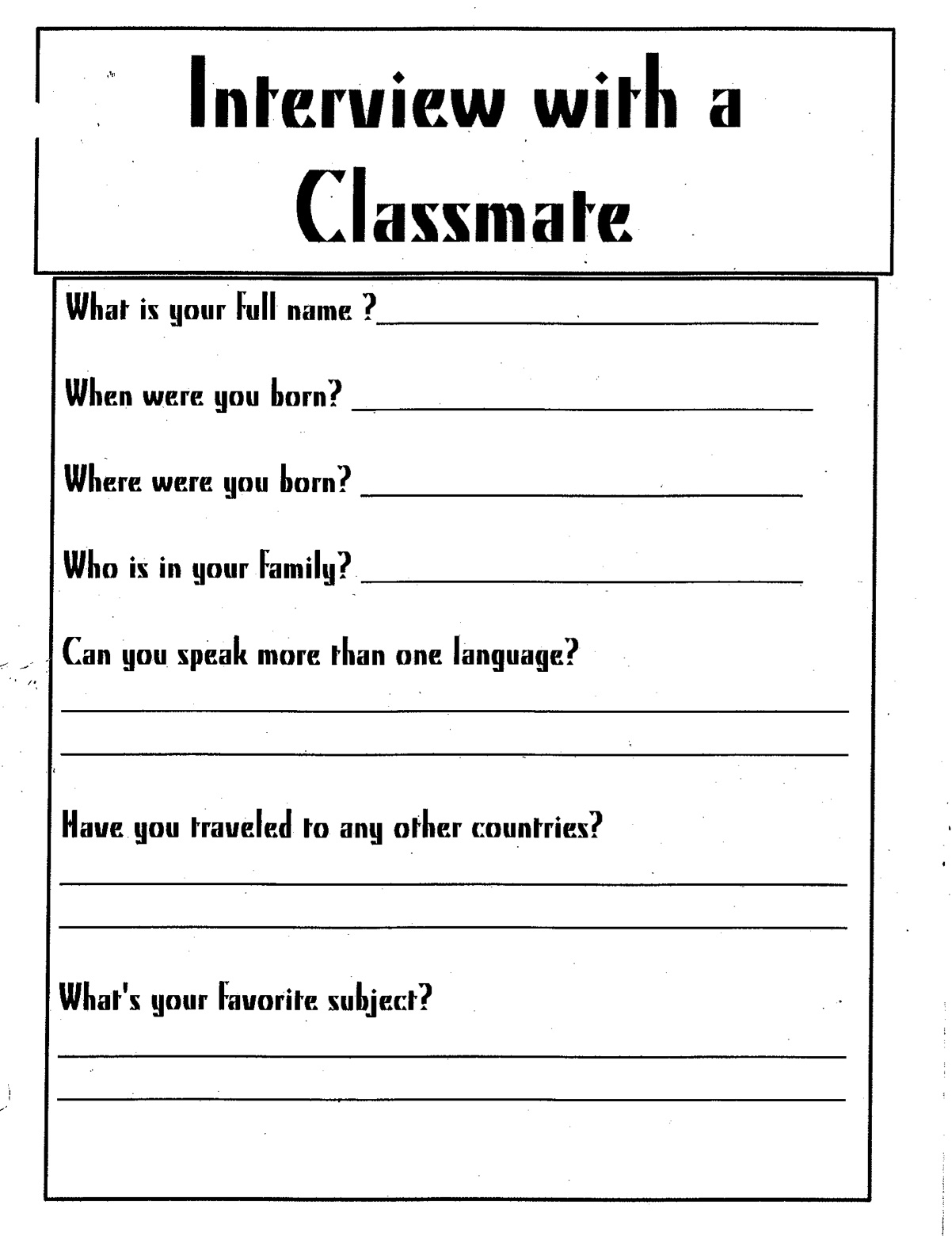
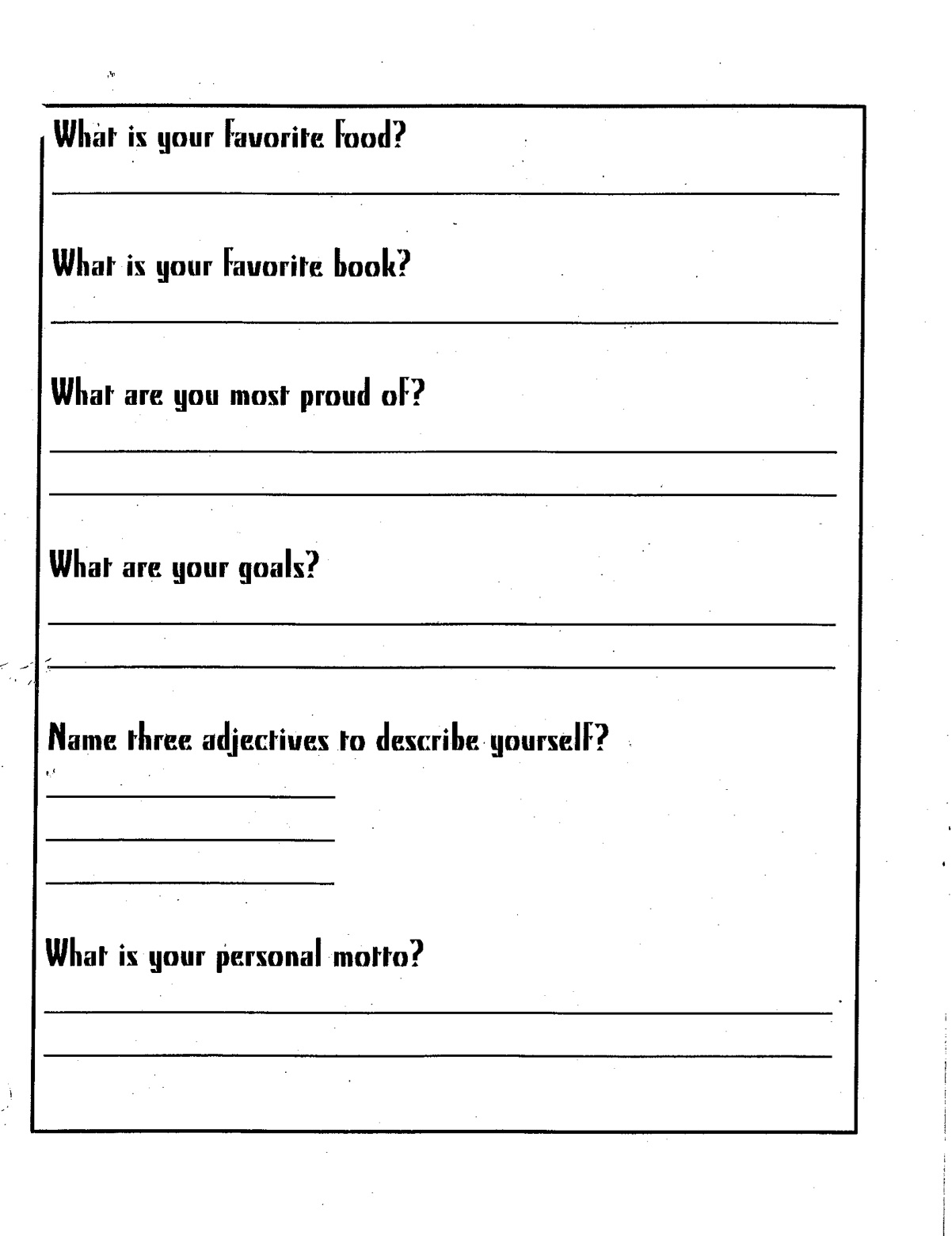
Do you have students who can tell you their ideas, but won't write?  Pair students who don't socialize together and have them interview one another.  This holds students accountable for writing while providing an outlet for sharing cultural backgrounds.

Self Reflection "Before and After"


How often do your students reflect on their writing?  As a second grade teacher, I struggle with this. So, I decided two create a self reflection sheet and a writing profile for students to complete.  The Before and After sheet is a template for students to write a list of what they saw in their writing before and after making the changes on their self reflection sheet.  You could attach the before writing sample to one side of a file folder and the after sample on the other side.  Then staple the before and after writing list.

The "Incohesive Writer"

Do you have students who don't include all of the elements of the story in their writing?  If so, you could use the rainbow writing technique.  The activity can be completed two different ways.  Students can write a rough draft on a given topic and then underline the story parts according to the rainbow revising code.  The second way could be used in peer revising session.  Students could trade papers and find the story parts.